Concrete · Grading · Drainage · Sitework
Concrete Restoration and Sitework in La Mirada, CA
We correct the base first, then pour.
Cracked and settling concrete is almost never a concrete problem. It is a base problem, a drainage problem or a reinforcement problem. We fix what is under the slab before we pour a new one, which is why ours does not do the same thing again.


Why the last one cracked
A Pour Is Only
As Good as Its Base
Concrete cracks for a small number of well-understood reasons. Pouring new concrete over the same conditions produces the same result, on the same timeline.
Pour and go
New Slab, Same Base.
- Break Out the Old Slab
- Set Forms
- Pour and Finish
- Cut Control Joints
- Compact the Base Properly, in Lifts
- Correct the Drainage That Undermined It
- Set Reinforcement to the Right Depth
- Grade so Water Runs Away from the House
- Detail the Joints Where Movement Happens
Skip the bottom five and the new slab
cracks the same way the old one did.
Lim Construction Services
New Slab, Corrected Base.
- Break Out the Old Slab
- Set Forms
- Pour and Finish
- Cut Control Joints
- Compact the Base Properly, in Lifts
- Correct the Drainage That Undermined It
- Set Reinforcement to the Right Depth
- Grade so Water Runs Away from the House
- Detail the Joints Where Movement Happens
Base, drainage, reinforcement and grade first.
Then the concrete.
How a pour runs
Remove, Correct,
Prepare, Pour
Most of the work in a good slab happens before any concrete arrives on site.
Remove and Assess
Old concrete out, base exposed. Now we can see what actually caused the failure rather than guessing from the crack pattern.
Correct
Drainage rerouted, soft spots dug out, base built back and compacted in lifts. This is the stage that decides how long the new slab lasts.
Prepare
Forms set to correct grade and fall, reinforcement placed at proper depth, control joints planned where the slab will actually want to move.
Pour and Finish
Placed, finished to the specified texture, jointed and cured. Site cleaned and spoil hauled.
What it costs
Priced by Area
And by Base
Square footage sets a floor on the price. What is underneath sets the rest, which is why we look before we quote.
walk-through
Priced by area and by base,
because what is underneath
sets the rest.
- Area and thicknessA walkway and a driveway that has to carry vehicles are different thicknesses and different reinforcement.
- Base conditionIf the base is sound, preparation is quick. If the soil has washed out, it has to be rebuilt before anything is poured.
- Drainage workCorrecting where water goes is often the real fix. It costs money and it is the reason the new slab outlasts the old one.
- FinishBroom finish, exposed aggregate and stamped concrete are increasing amounts of labour on the same volume.
- Access and removalGetting equipment to the pour and hauling the old slab out is a real share of the cost on tight lots.
Backed for five years
If Our Workmanship Fails,
We Come Back and Fix It.
Five years of workmanship warranty on the work and on the finish that closes it. Same company, same phone number, same crew. Terms are written into your contract before you sign anything, so the promise is a document rather than a sales line.
CSLB #1079728 · Class B, General Building · Active through 08/31/2027
$25,000 contractor bond, Atlantic Specialty · $2,000,000 general liability, State Farm
Recent work
From Our Own Jobs
Photographs from our own sites — not a stock library. Every one of these is work our crew carried out.

Placing Against a Block Wall
Concrete placed and worked against existing block. Formwork and base prep decide the finish long before the truck arrives.
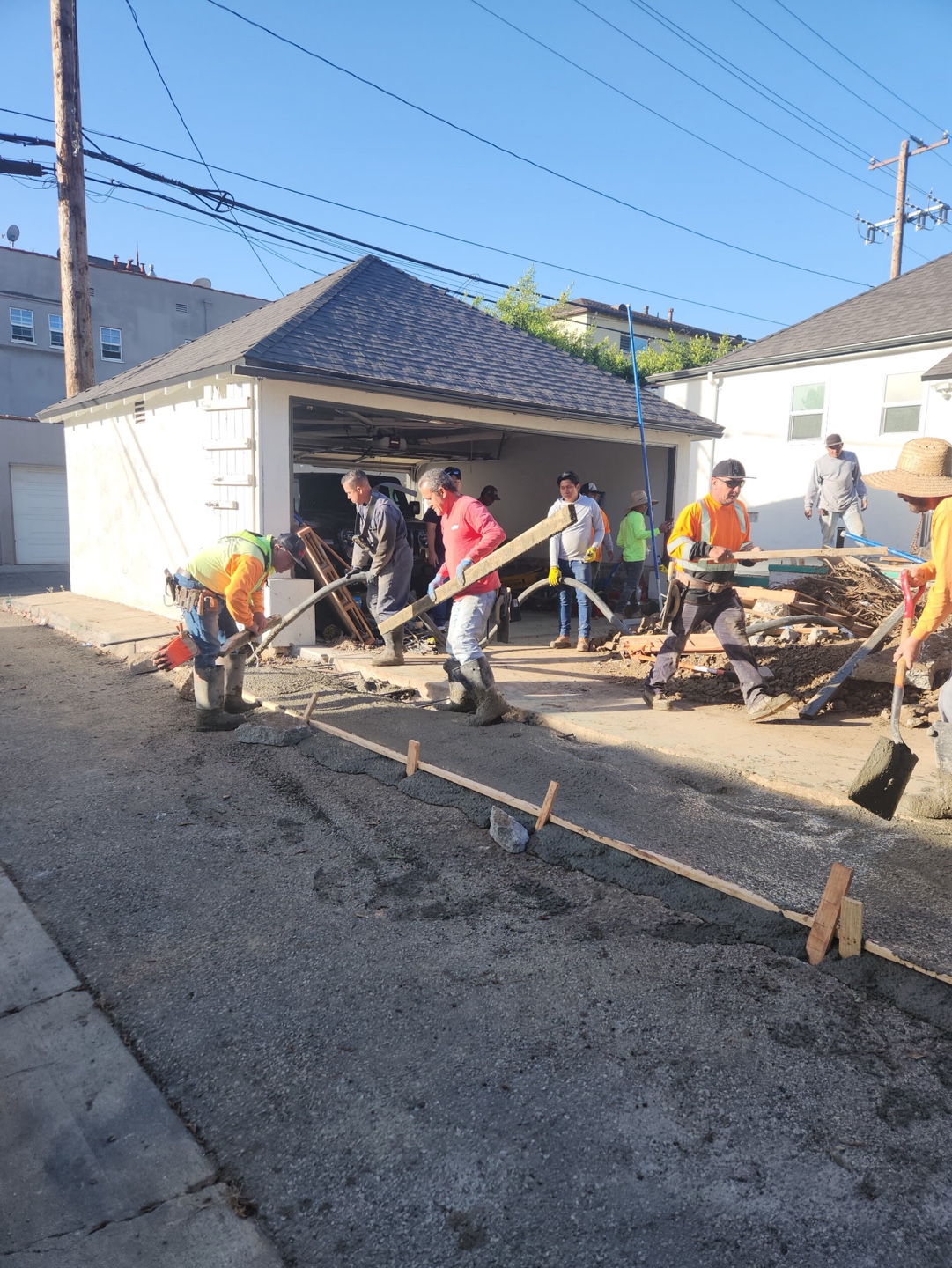
Setting Forms Ahead of a Pour
Our own crew forming and grading. Every stage on this site is run by the same company that quoted it.
Finished and Floated Flat
Placed, floated, jointed and cured. The joints go where the slab will actually want to move.
Service area
Where We Work
Based in La Mirada, on jobs across Los Angeles County and north Orange County.
Questions we actually get
Before You Call Anyone
Why did my last driveway crack?
Usually one of four things: the base was never compacted properly, water is getting underneath and washing it out, there was no reinforcement or it sat at the wrong depth, or the control joints were cut in the wrong places. All four are fixable, and all four come back if the new slab goes over the same conditions.
Can you match my existing concrete?
New concrete never colour-matches old concrete exactly — it cures lighter and weathers in over time. We can match texture and finish closely, and we will tell you honestly at the walk-through what the joint between old and new will look like.
Do you do the drainage as well?
Yes, and on a lot of jobs it is the actual repair. If water is running toward the house or pooling under the slab, correcting that is what stops the failure repeating. Pouring without it is money spent twice.
How long before we can drive on it?
Foot traffic and vehicle traffic are different waits, and both depend on weather and mix. You will get real dates at hand-over rather than a number that sounds good. Driving on it early is a good way to crack a slab that was otherwise fine.
Are you licensed and bonded?
Yes. CSLB license #1079728, Class B, General Building Contractor, active through August 2027. We carry a $25 through Atlantic Specialty and $2 through State Farm. Verify the licence yourself at cslb.ca.gov before you let anyone into your house — we would rather you did.
What deposit do you take?
California caps a residential down payment at $1,000 or 10% of the contract price, whichever is less. Payment after that follows a written progress schedule tied to completed stages, so you always know what you are paying for. If any contractor asks for a large payment up front, that is your signal to walk.
Free estimate
Tell Us What
Happened
The more you tell us, the more useful the first call is. If water is moving right now, don’t type — call.
Call (714) 888-5443